NEIU students and employees can visit the latest exhibition, “Aquí en Chicago,” for free at the Chicago History Museum (CHM) until November 6, 2026.
The exhibition debuted after high school students from the Instituto Justice and Leadership Academy (IJLA) protested CHM in September 2019 due to the lack of Latino representation at the museum.
Fifteen IJLA students from a history class were “on a field trip to the Chicago History Museum in mid-September to analyze who was represented in its exhibits and who was left out,” as reported by the Chicago Sun Times.
After six years, this bilingual exhibition showcases art, photographs, oral interviews, clothing, everyday objects and historical artifacts from more than 20 countries of Latino heritage. Among featured items are a Young Lord’s beret, a traditional Quechua ceremonial mask, house music and a paletero’s cart.
Some of the pieces on display were selected from different museums in the U.S., such as Gato Negro Press, which was political artist Carlos Cortez’s press from the National Museum of Mexican Art.
“This exhibition is about the longstanding presence of Latino/a/e communities in and around the Chicagoland area. It came about in response to the students, and the story of their work with the Museum is at the heart of this exhibition,” said exhibition curator Dr. Elena Gonzales, CHM Curator of Civic Engagement and Social Justice. “‘Aquí en Chicago’ is a direct answer to the students’ questions about their communities’ histories.”
Additionally, a federal injunction later reinstated some of the National Endowment for the Humanities funding after the Trump regime had terminated “$175 million in grants by the National Endowment for the Humanities, which funds programs in 50 states,” as reported by WBEZ Chicago.
“We were very fortunate to have funding from the National Endowment for the Humanities and the Institute for Museum and Library Services, as we have for many exhibitions, for this project,” Dr. Gonzalez said.
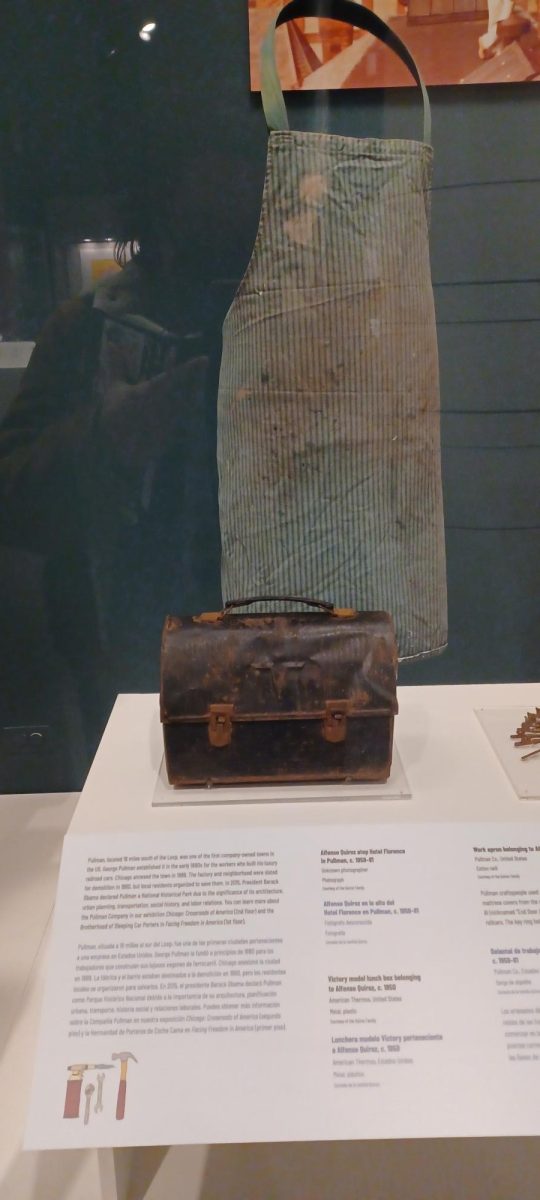
One of the items that was donated to this exhibit was Alonso Quiroz’s apron and lunchbox when he worked at the Pullman Company for 22 and a half years.
Esther Trujillo has been involved with the project since 2019, when community artist Nicole Marroquin invited her to support IJLA students’ demands from the museum.
“One thing that was really important about this project was community curation, so one of the ways that the museum did that was that they created what was called a community collections workshops,” Trujillo said to the Independent. “And they talked to members of different community organizations about the exhibit and said, ‘Hey, you know, look through your house, what do you have that you want to, you know, contribute in the form of an object, an image, a story,’ and so oral histories were collected, items were collected, photographs have also been collected.”
This is the first exhibit of its kind that uses a community advisory committee and a community awareness council and incorporates a student internship for research.
Angie Guzman, a curatorial fellow and graduate student at the University of Illinois Chicago, contributed to the exhibit with her research on Corridos, a type of Mexican folk music, and musician Jesus “Chuy” Negrete. Her blog post, “Sounds of Resistance: Corridos in Chicago,” was published on the CHM website.
Attendees can view the contributions from students’ research as labels. Guzman’s research on corrido is displayed beneath Negrete’s guitar.
Although the community advisory committee lost contact after the IJLA students graduated, it managed to ensure that the students’ demands were respected by the curators, as explained by Trujillo, who is a member of the committee.
At the end of the exhibit, there is a digital kiosk where participants can submit their own images using a QR code. The CHM team will review these submissions, and once accepted, the images will be publicly displayed.
Over 200 images have been submitted, featuring vintage images from the 1950s and 1960s, alongside contemporary photos contributing to the community curation of this exhibition.
NEIU students and employees can visit the CHM for free through a partnership between the institutions. This partnership also provides NEIU students and employees with access to discounted group tours, such as guided gallery tours, neighborhood walking tours and special neighborhood walking tours, according to their website.
To get into the CHM for free, current NEIU students and employees must present a valid NEIU ID at the admission desk.