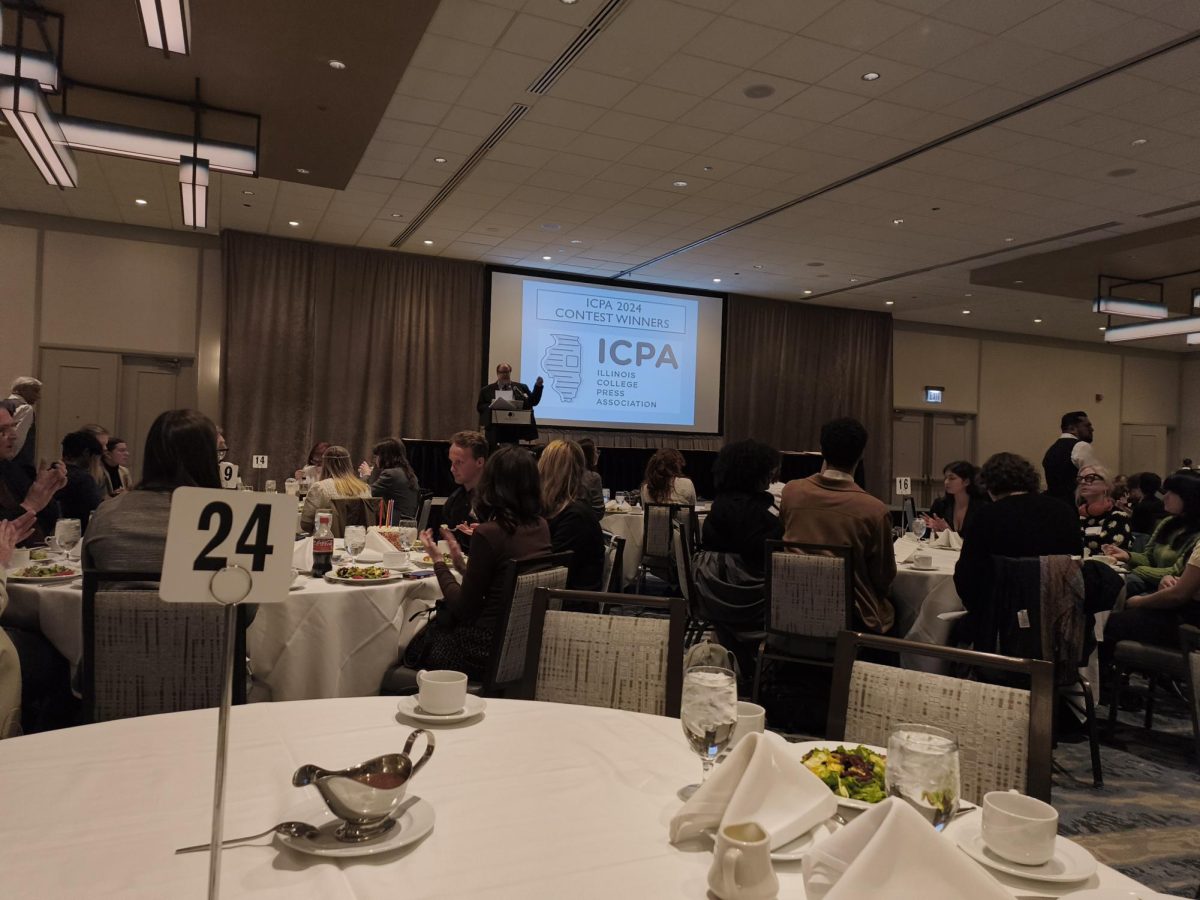
University and community college students routinely attend conferences as a common practice to learn beyond the classroom, network with students from elsewhere, discover new innovations, explore the latest research and prepare for work after graduation. During the latest academic year, the Independent had the opportunity to attend the annual Illinois College Press Association (ICPA) conference and awards ceremony, much like the past two years.
The ICPA conference was held at its usual location at the DoubleTree Chicago—Magnificent Mile, 300 E. Ohio St.—on Feb. 28 and Mar. 1, 2025. They had many informational sessions, publication critiques, a photo competition and a luncheon with an awards ceremony. Attendees traveled from many different colleges and universities in Illinois. It was not much different than past ICPA conferences, but it did have minor tweaks and slightly varied sessions.
11 sessions took place on Friday, and another nine sessions took place on Saturday. Typically, the ICPA conference is structured in such a manner that every two, three or four sessions are scheduled at the same time in different rooms, and attendees decide which ones are of greater interest to sit in on. This is the typical structure of most journalism and non-journalism conferences.
“You learn so much in a classroom, but then going to these conferences gives you a different experience: you’re in a new place; there’s different people; they all have different experiences,” Maggee Bleyer, journalism major at Illinois State University (ISU) and editor-in-chief at The Vidette, said. “And it’s interesting to learn how they navigate things in journalism or how they learned certain things [and] what experiences they have, so I encourage students to go to conferences.”
“‘Knowing your press rights in an Era of Authoritarian Government’—I thought that one was really interesting because we got to learn about just how schools and college [and] university news organizations should navigate a new political environment,” Bleyer said. “And then from [Saturday], I really enjoyed the website critique. Our website developed a new look recently, and so it was very valuable to learn what was working [and] what might need to be improved.”
The press rights seminar mostly gave information and tips about covering political, governmental, legislative and policy news topics. One tip included: “You have the right in every state in the country to take photos, to take video of police action, so as long as you’re doing it in a non-disruptive way and not interfering with police activities,” Mike Hiestand, staff at Student Press Law Center and the session’s panelist, said.
Hiestand talked about reasons that the Student Press Law Center was founded and actions that they currently do to help student journalists. “Censorship was actually the one reason that we were founded—about 1974 and particularly for high school students,” Hiestand said. “It remains the number one rule that they contact us.”
In addition, Student Press Law Center helps student journalists to access public records, information on public meetings and copyright questions, and they have a legal hotline. Hiestand has over 35 years of experience and has taken 22,000 calls on the hotline in that time while doing this work.

—
A session that could be considered the most important for staff at the Independent was titled, “Leveraging your journalism skills into a non-journalism career” because NEIU does not have an official journalism major. The 50-minute session had three panelists giving their work and educational backgrounds. Just like any life skill, the more that writers do the skill, the easier it gets. “Having true storytelling skills is what really sets you apart and kind of gets you where you want to go,” Mariah Kolodziej Oscar, strategic partner marketing manager at Autodesk and a session panelist, said.
As a sign of encouragement for individuals of any major at NEIU to become writers, it is an incredible experience to get involved in publishing stories. “I would have loved to do more interviews, like going out and interviewing people for assignments,” Saba Aamir, intern at MxD, graduate student in digital marketing at Northern Illinois University (NIU) and a session panelist, said. “I think it would have helped me build a lot of my communication [and] speaking skills as well.”
“Your first job is not going to be your forever job,” Angeline Schmelzer, an Oak Lawn-Hometown School District communications staffer and a session panelist, said. Along the same lines, “I think that almost goes into your point [of] your first job might not be your dream job. I mean I was 22 years old writing about menopause, [and] that was not my dream job, but it’s all about how you can reframe it,” Oscar said.
Networking was an important albeit clichéd last remark of the non-journalism career session. “Another word of advice in the job search and you touched on it in the beginning is networking, and I know it’s kind of cringe, but I think that there’s different ways that you can network that are really impactful,” Oscar said. “Don’t be afraid to reach out to people even if they are only acquaintances and be like, ‘Hey I saw this job posted [and] I’m really interested. Here’s XYZ [reasons] why I think I’d be a great match for this role.’ Go have a cup of coffee with them. I did that.”
Networking may feel like it is not going anywhere at times, but it is all about maintaining connections, having a positive perspective, getting the resume into some important people’s hands and extending one’s network of people who may help to get a great job. “I think until you land that first job it is hard to get there, but always keep putting yourself out there,” Oscar said.
—
Artificial Intelligence (AI) is such a hot topic in the world today that this one conference had two sessions dedicated to it: “Ethical AI for Non-IT professionals: Transforming Journalism” and “Developing your audience with trending stories and AI.” “I personally do not use AI to write stories or develop stories,” Bleyer said. “I just have not tried AI yet.”
However, from the two AI sessions, Bleyer shed light on how AI could potentially be used in journalism. “People who enjoy using AI really like using AI services to develop story ideas and potentially help them figure out some questions that they could ask people,” she said. Thus, utilization of AI could help to develop stories in newspapers and news magazines and create interview questions. During a different session, Oscar said, “I’m still learning digital media trends [and] how I can leverage AI in what I’m doing.”

Jackie Spinner, a faculty adviser at the Columbia Chronicle at Columbia College Chicago, talked about a very important topic concerning how to navigate financial challenges in higher education during the “Higher ed in crisis” seminar. Her talk captured many attendees’ attention as she was providing an in-depth look at the financial challenges facing colleges and universities today.
“Every bit of financial information you want about your institution, they have to file it. So even if you’re at a private institution, they’re still required to report how much the president makes, and who the top earners are and what their debt is like,” Spinner said.
Spinner emphasized the pervasive issue of budget deficits, their impact and their importance of financial transparency. According to Spinner, it is estimated that one-third of universities will shut down in ten years because of debts. To overcome this, it’s very likely that a university will increase their tuition and enrollment rates or reduce staff, according to Spinner.
“So we have a problem at Columbia College,” Spinner said. “We have a deficit. So we have for the last two years basically have been covering the looming financial collapse of our institution.”
Spinner highlighted different tools in which the public can access institutional financial data, such as the Integrated Postsecondary Education Data System (IPEDS), National Association of College and University Business Officers (NACUBO), county recorder or tax assessor’s office, accreditation bodies and, for private institutions, Form 990.
Concerning Columbia College Chicago, “We only had a $19 million deficit. We had a strike, and it doubled to $38 million,” Spinner said. “And now it’s back down to about $17 million. So we’re doing okay.” Any student journalist can figure out the budgeting, financial and deficit problems that are going on at his or her university. “You can very easily go to the Foundation Center or to GuideStar or ProPublica and figure out, ‘Does your institution have a deficit?’” Spinner said.
Turning to a discussion about the reasons for debts in universities, Spinner pointed to national trends such as declining enrollment and tuition dependency as key factors driving deficits. Spinner stated the need for historical context and comparative data in reporting by referring to trends that diminish demography and federal funding cuts that exacerbate institutional issues.
Spinner also advised student journalists to look beyond the immediate statistics and study systemic and external variables that influence financial decisions. This session was an important reminder of the shared challenges within higher education and the role of context-driven reporting in fostering accountability and transparency.
The topic sessions differ from year to year, such as from offering one AI session in the past and now offering two of them. Bleyer offered suggestions for other sessions that may be valuable to student journalists in upcoming ICPA conferences. “I do wish there was maybe a session about social media [because more multimedia sessions might be present],” continuing, “[it’s] just [that] news is changing every day and it’s definitely changing more into a digital social media type of environment,” Bleyer said. “So being able to learn how to communicate news on social media platforms would have been a cool session to attend, and if they add that next year that would be really cool.”
This year’s ICPA conference offered several other seminars during the two-day event, such as covering sports games beyond the gamer, discovering enterprise stories, publishing bilingual content in Spanish and English, using AI for analyzing website analytics and enhancing sports storytelling. The Independent will undoubtedly receive the opportunity to attend next year’s ICPA conference, but only time will tell which old and new writers will be attending. It could be you!