The American Public Health Association (APHA) hosted more than 10,000 public health professionals, students, educators, exhibitors and public health leaders from around the world at its 2025 Annual Meeting and Expo in Washington, D.C., which took place from November 2–5. This year’s theme was “Making Public Health a National Priority.”
The opening session was led by APHA President Deanna J. Wathington, MD, MPH, FAAFP, followed by remarks from APHA Executive Director Georges C. Benjamin, MD. These remarks framed the theme for a conference focused on innovation, equity and strengthening public health systems across the country.
Highlights of the meeting included over 4,000 scientific sessions consisting of poster and oral presentations that highlighted quality research across many different fields of public health and topics from climate change and health equity to infectious disease prevention, maternal health, mental health and community resilience. Many students, faculty members and organizations presented their work—and Northeastern Illinois University (NEIU) was proudly among them. Several NEIU students, including myself, and our faculty represented our university and presented research at the conference.
One such presenter from NEIU was Dr. Chika Ejike, Master of Public Health (MPH) faculty, who presented her research poster titled “Health Equity and Acculturation: Associated Psychosocial Outcomes Among Immigrants.” NEIU graduate Maureen Burns also gave an oral presentation – a highly competitive format – on “Teen CHWs: Investigating the Challenges and Benefits of Engaging Marginalized Youth in CHW Training.” Her presentation, based on her internship research on youth Community Health Workers, was well-attended and inspired a thoughtful, engaging discussion.
My own research, “The Role of the Pomodoro Technique in Reducing Stress and Preventing Burnout Among College Students, with a Focus on Neurodivergent Students,” was accepted as a poster presentation in the Mental Health Section. I used the Mike Morrison-style poster template recommended by APHA, which attracted a steady stream of attendees and generated meaningful conversations. The study, conducted among NEIU students, revealed promising preliminary findings, particularly that many students struggle with time management and procrastination, leading to elevated stress levels.
Attendees could volunteer before and during the conference, in addition to participating in many section presentations. Serving as a reviewer for the Epidemiology Late Breaker and the Nursing Section abstracts gave me an insight into how APHA evaluates submissions for relevance to current public health priorities, methodological rigor, and clarity. Moderating an oral session and a lightning session also revealed just how tightly structured this conference was behind the scenes. The moderator role calls for keeping presenters on schedule, managing audience questions, and keeping discussions focused and respectful. Facilitating these roles showed just how much coordination is required to keep hundreds of sessions running smoothly and how volunteers play a critical role in maintaining the flow of a national conference of this size.
The APHA Annual Meeting provided endless opportunities for learning, networking and collaborating with public health professionals at all levels. Students particularly benefited from sessions specifically tailored to their interests. One of the key activities presented during the conference was the APHA Student Assembly, which exclusively supports students through travel scholarships, professional development workshops and networking mixers that would link emerging public health professionals to experienced mentors.
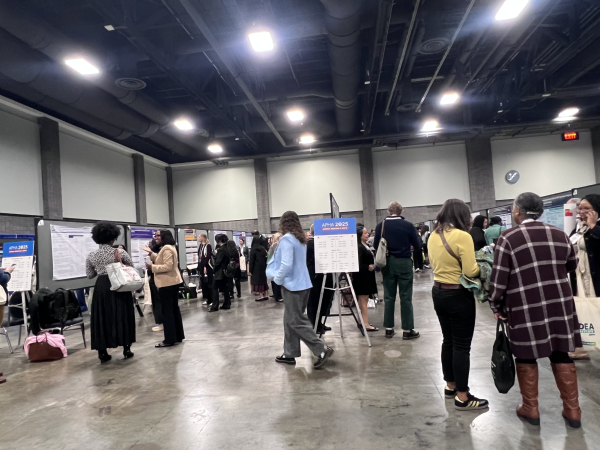
One of the most impressive things about APHA is its inclusiveness. The conference is not solely for professionals in the field of public health; it encompasses a wide array of disciplines. Whether a student’s background is in nursing, social work, environmental health, community health work or any related field, APHA has sections, forums and caucuses dedicated to your area of interest.
At the height of the conference, almost 200 poster presentations were going on simultaneously, along with innumerable oral presentations, lightning sessions and roundtable discussions. Navigating such a vast and fast-moving conference was overwhelming and an inspiration in equal measure, underlining the enormous collective effort being made at a global level to improve public health.
Other perks of the conference included, but were not limited to, a free professional headshot lounge sponsored by Walden University, which was very popular among students and early career professionals.
As the largest gathering for public health in the world, APHA remains a critical space of collaboration, advocacy and innovation. For students, APHA is an opportunity to step into the professional community, gain exposure and see how their passions can shape healthier communities. NEIU’s involvement in APHA 2025 was a proud reminder that our students and faculty are active players in the national public health dialogue and are helping shape the next generation of public health leaders.
The APHA 2026 Annual Meeting will be held in San Antonio, Texas, from November 1–4. The theme for 2026 is “Together We Thrive: Health Across the Lifespan,” meant to reflect APHA’s continued commitment to improving health outcomes at every stage of life.