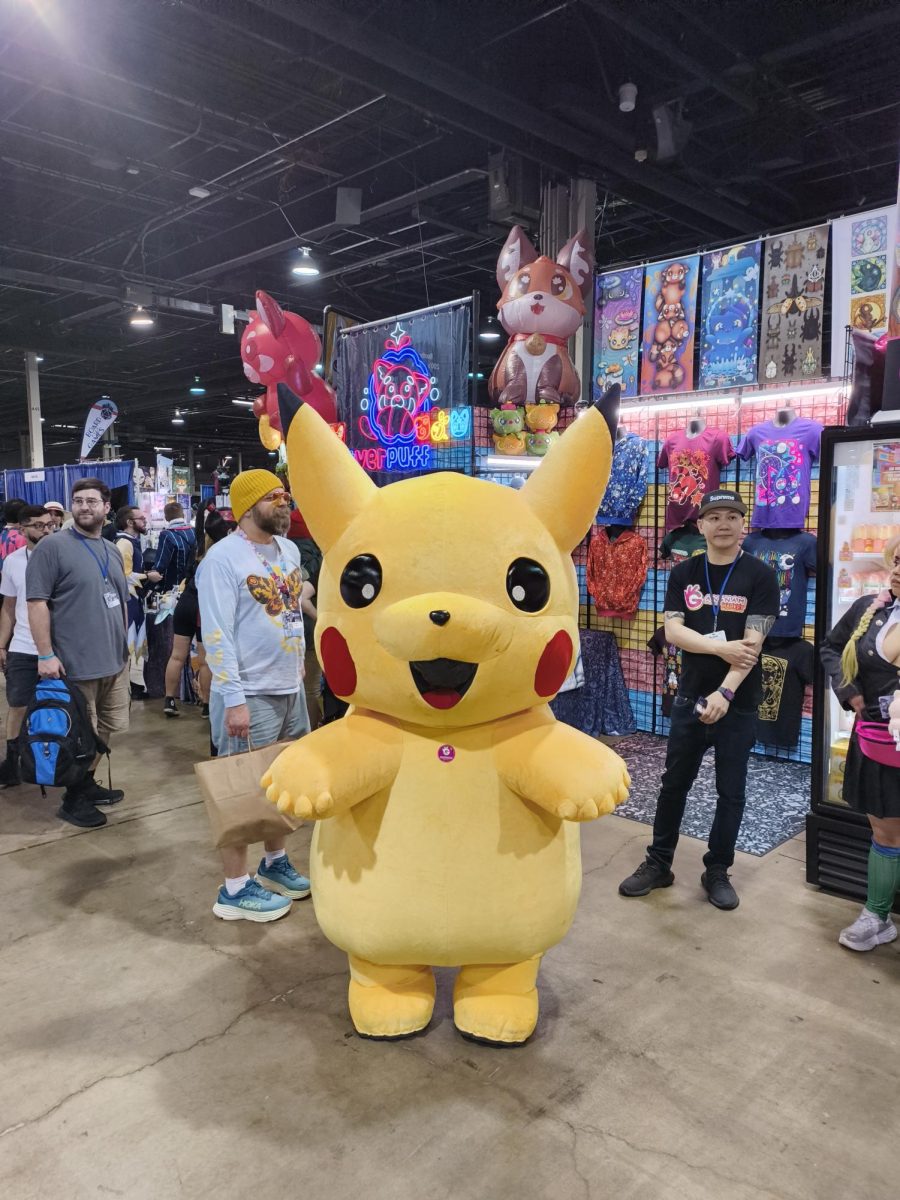
Anime Central (ACen) took place at Donald E. Stephens Convention Center in Rosemont from May 16 to 18, 2025. It is most known for selling anime merchandise and gaming-related content in the exhibition hall while cosplayers interact with one another. However, outside of the exhibition hall, several workshops took place throughout the three-day convention for fans to learn about their favorite anime franchises, ask questions to their favorite anime celebrities and learn about the process of working in anime and gaming industries. One particular workshop, titled “PANEL: Success is 90% Perseverance,” related to how NEIU students could escalate themselves in their post-college professional work.
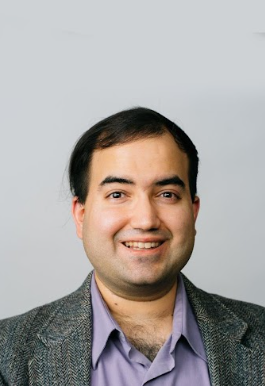
Devin Wilson, Elisa Teague, Adam Petkovic and Austin Woodhouse were the four panelists part of this workshop about being successful and persevering at life skills and careers. Each of them offered unique advice for NEIU students to pursue creative works. Each professional creative-driven person had a personal definition of success based on their experiences and jobs.
Wilson is an RPG designer and YouTube content creator focused on video editing, photo editing and social media management. “You could consider success for me to be that I now do work my dream job,” Wilson said. “So that is successful as far as I’m concerned.”
Petkovic is a tabletop role-playing game (TTRPG) designer and editor, writer and performer on Six Sides of Gaming. “Success to me is again just if you are doing what you love doing, and you are somehow carving a way to do it, that’s successful to me,” Petokovic said.
Woodhouse, a performer on Six Sides of Gaming, tests out the rules and monstrous characters written for the game. “For me, success has been a statement of just my perseverance, just getting over my inability to feel that I’m somewhat competent even at this,” Woodhouse said.
Teague is a tabletop game designer, RPG author, streamer on Six Sides of Gaming and consultant within the gaming industry. “So I’m going to split the difference a little bit and say both are important for success—do[ing] the thing that you love [and] being able to put food on the table.” In other words, she is referring to doing a hobby for work while also making a sustainable living.
Wilson’s friend had a choice between being a low-paying creative or a high-paying industrialist. “I have a friend who went to college for video game design and that’s his passion,” Wilson said. “That’s what he loves doing. He wants to be a video game designer, but he got sucked into a factory job at a Toyota plant that pays three times the amount that any entry-level position in the video game industry does.” Wilson’s friend had the plan to do the industrialist job until he gets “a nice nest egg” and then “start doing a video game.” Ten years have elapsed for Wilson’s friend, and “he’s still working at the [same] Toyota plant because they kept giving him raises,” Wilson said.
Teague insisted on how “there needs to be a balance” because the same skills used in one industry can be used for “work in an office in a cubicle,” Teague said. Working at a corporation that she has no passion for would not allow her to be as “successful in the way of having self-satisfaction.”
According to Wilson, waking up, not being miserable, being excited to get to work, wanting to do the work, doing the work and caring about the work allows one to be successful. “I think for success, everyone can kind of agree that that is generally a good balance.”
“So for the longest time I was hopping between job to job that, you know, put food on the table, kept the roof over [my] head, kept the hydro and the gas flowing,” Petkovic said. “Sometimes this thing that I want to do creatively might not make as much money as the things that I’m currently doing,” Petkovic elaborated. “But I will feel at the end of the day better that I at least tried.”
“I try to keep going with it because if you don’t try, then it will never fail, but if [you] do, there is always the chance that it grasps onto something and grows into something bigger,” Petkovic explained. In other words, when a creative work is in progress, there is a chance of a success and a failure, but by never trying to be creative, a person will never succeed or fail at creating something great.
Teague was originally “an English major and a religious studies minor” at the University of California, Santa Barbara with the goal of doing “allegorical fantasy writing,” she said. Teague’s parents told her, “You should do that on the side. You’re never going to make any money.” “Because of the way that my college program worked, my major switched automatically from a creative writing major to like an English lit major” with the prospects of “being an editor or a teacher, [and] that is not what I want to do,” Teague explained. She transferred colleges and learned business skills in a fashion design program with an emphasis in apparel manufacturing.
Teague used the business skills that she learned to run a business, making cost sheets, profit and loss statements and other manufacturing necessities. Ultimately, she started a gaming company with her brother after he graduated from business school. She is now a creative who manufactures “board games and card games.” Teague’s academic and career journey is a shining example to NEIU students that it is entirely fine to be in one major and work in something completely different because professional skills are entirely transferable from job to job.
Woodhouse has done jobs like “acting on live stage” and “writing like a one shot,” which “I’d never really done, never saw myself doing, it was ‘I’ll try it, we’ll see if I enjoy it,’” Woodhouse said. He said ‘yes’ to new opportunities, and he encouraged NEIU students to try new things, develop new skills, see if they want to progress with those skills and possibly make new careers out of those skills. By diversifying skills as much as possible, NEIU students have limitless possibilities in the workaday world and more options when it comes to professional work after graduation.
Wilson’s sentiments are parallel to Woodhouse, “You always want to be able to challenge yourself, try new things [and] keep moving forward because otherwise you get complacent and then you can easily lose the thing that you’ve been fighting so hard for.” Wilson thought about a David Bowie quote to aid his understanding in how life activities work.
“If you feel like you’re in a pool, and you’re touching the [floor on the] shallow end, you need to go deeper,” Wilson said. “But if you feel like you’re nearly keeping your head above water and barely drown and just about to drown, you need to take a step back.” In other words, this sentiment means to try new things, but know one’s boundaries and limitations in life.
“If you feel like you’re just managing to tread water, and you’re managing to keep yourself afloat, that’s where you’re supposed to be, and that’s also a way to get through imposter syndrome,” Wilson elaborated. If NEIU students feel that they are in the place they are supposed to be in life, it means that “you didn’t con your way there,” Wilson said.
Woodhouse responded to a question from an audience member about having multiple passions that could become full-time careers. “There is going to be some amount of overlap whether it is design, doing voice acting, doing playing like performing or doing artwork,” Woodhouse answered. “There will be a lot of skills that you can transfer from one thing to do another.”
Wilson echoed Woodhouse’s sentiments,“It’s my experience that it’s very rare for any two or three different skill sets or passions to never overlap.”
Teague added a statement about the differences between taking high-paying industry jobs versus low-paying fun and creative jobs and choosing one option over the other. When multiple opportunities arise and each opportunity features a different passion, then “sometimes it’s better to take the smaller, lower-paying gig that will lead to better opportunities later than a, you know, a cash drop that is going to fizzle out because you’re going to be replaced immediately,” Teague added.
The discussion of being successful and persevering in life went in-depth by the four creative panelists. They gave several lessons that NEIU students could learn from and keep in mind for the future of their careers, regardless of how creative or analytical their jobs may be. The lasting lesson for NEIU students to take from this workshop was that in order to have a fulfilling life, one shall have a steady work-life balance, be sure to earn enough to sustain oneself and also find a job that satisfies one’s creativity. ACen 2025 featured other workshops like this with real-life lessons as well as fun fandom experiences with celebrity panelists, sneak peeks of upcoming episodes, and question and answer sessions about celebrities’ personal lives coming from the audiences’ curiosity.
Next year’s edition of ACen will take place from May 15 to 17, 2026.