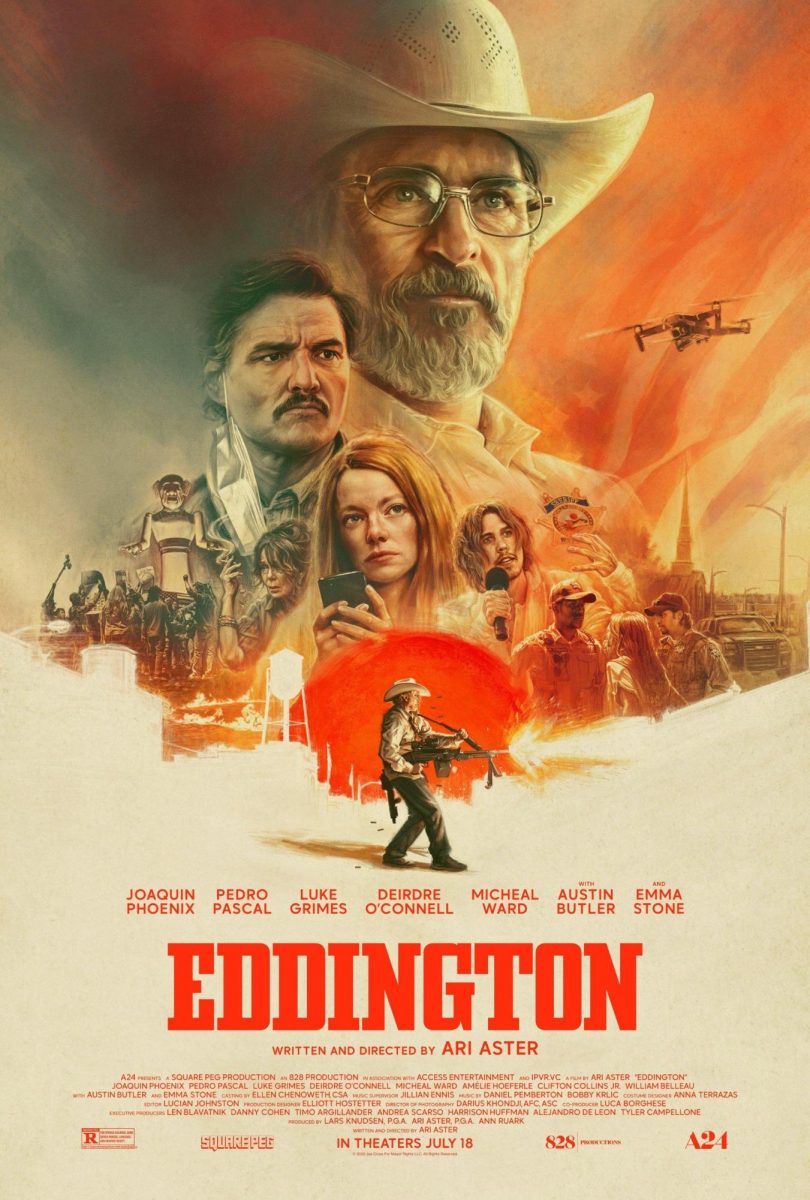
A24’s recent film, “Eddington”, written and directed by Ari Aster, is a dramatic period piece that stands as a firm, reflective sociological indictment against the overall state of the USA: particularly, Democrats, Republicans, and the Division-Driven Technology that powers both of them.
Ari Aster:“What happens when these atomized people who are living in different bubbles of certainty start bumping up against each other?”
Democrats Ted Garcia, played by Pedro Pascal, is the current Democratic mayor of Eddington, the fictitious New Mexico town of 2,435, and he’s seeking re-election in May 2020. COVID-19 and the death of George Floyd are both happening concurrently, as Garcia’s adamant messaging remains that both these things are bad. Admittedly, Garcia mostly exists as a liberal figurehead: delivering statements, enforcing weak policies, and never actually making substantial change. His lack of political effectiveness, despite posturing during election season, reminds me somewhat of John Fetterman and how quickly he turned face once he was elected, or even Kyrsten Sinema’s history of voting against progressive legislature despite being on the blue team. Soon into the film, we see Garcia attempt to enforce a mask policy at a grocery store but remain silent on the police brutality end. Both these issues don’t seem too prevalent in small-town Eddington, yet the activistic youth are upset enough to protest anyway. They lack a cohesive goal and are motivated mostly from impulsive, reactionary rage towards local law enforcement and all white people despite them having no direct influence in George Floyd’s case. I have to come clean that I saw a reflection of myself in these naïve radicalized left-leaning folks because I still empathize entirely with their cause but do think sometimes the rhetoric can be tangled a bit with snarlingly dismissive purity tests, the shortcomings of modern liberalism. They lack the unity of the right as a result of justified exhaustion leading to constantly robbing people’s benefit of the doubt, sometimes drawing dramatic conclusions from the most mundane interactions. Their tendency towards liberal performatism instead of more calculated change in local government weakens the left as a whole while tainting their reputation of friendly-fire scoldings. Who knows? Maybe burning a Zozobra that says ‘white supremacy’ will end racism.
Ted Garcia:“You know how death works?”
The mainstream left is overall portrayed as a vicious pack of white-guilt ridden neolibs with hearts of gold desperate for change yet lashing out at anyone around them, similar to Goya’s Saturn Devouring His Son.
Republicans Joe Cross, played by Joaquin Phoenix, is the head honcho in the red corner of the ring. He’s the personification of the Republican party hanging on by a loose thread, a pot slowly boiling, ready to detonate at a moment’s notice. He’s the kind of guy who’s seen one too many western films and thinks he should confront the world as the most righteous man on the planet. On a whim, he flippantly decides to run for mayor after seeing a man refused service from a grocery store for not wearing a mask. For reasons unknown, running for mayor upsets his wife, played by Emma Stone. She happens to be the ex-wife of his opponent, Garcia, adding a bit of powder to the keg. His wife and mother-in-law are subserviently influenced by an online nut-job conspiracy influencer named Vernon, played by Austin Butler, who furthers their neurotic bigotry towards whoever they’re told via warped, manipulative logic. He’s a big, crazy Alex Jones-type character from yesteryear or, more recently, podcasters like Joe Rogan, foaming at the mouth, spouting unfactual ragebait left and right.
Joseph Cross:“Don’t make me think, just post it.”
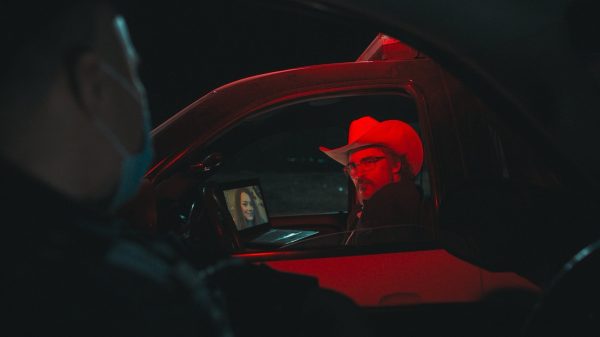
Joaquin Phoenix’s Joe Cross lit by the red of police lights.
The tipping point of the film is when Garcia comically slaps Joe, twice, to Katy Perry’s “Firework” of all things. Joe vents the residual anger by impulsively murdering a homeless man in cold blood. Joe goes on to assassinate his political opponent, all the while enduring a COVID infection, slowly multiplying in his body. You’d think that would be the end of this COVID western, right? Who else is there to fight? Surprise, surprise… Ultra Military Antifa is here and they’re flying in on their private jet just to get Joe Cross in little old Eddington, with a population of just over 2,000 people LMAOOO!!!!!
A Covid-infected republican sheriff blindly shooting a massive machine gun at unknown enemies in the dark with reckless abandon is The Quintessential American image.
Division-Driven Technology Instagram is the enemy. TikTok is an infestation. Facebook is the antichrist.
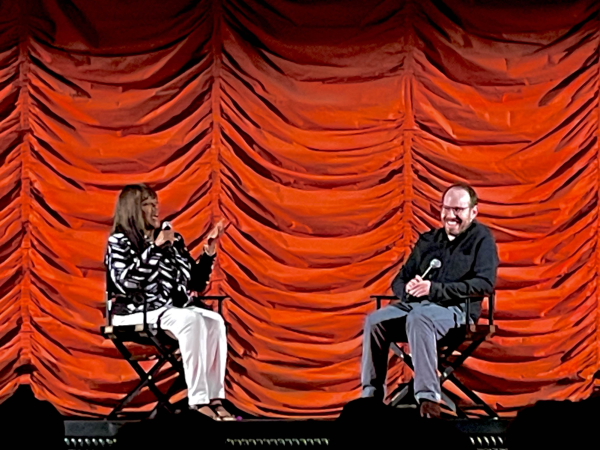
Q&A for Eddington moderated by Chaz Ebert at Chicago’s Music Box Theater.
The silent antagonist looming on the narrative horizon is the giant tech company’s data facilities which are being greenlit by Garcia in the background. During a live Q&A at the early screening I attended, when asked to summarize his film in one sentence, Aster said “A hyper-scale data-center being built outside of a small town.” That’s the seed that sprouted the current Artificial Technology blight we feel more and more each day. We live in a panopticon of training data. These companies are sucking up the water in New Mexico during a drought to fuel machines that pin middle/working-class people against one another ideologically, while physically separating them by eroding real-life third spaces. I argue they’re the main contributing factor that lead to Joe Cross’ disability, which binds him to a wheelchair by the end. I don’t think the final shootout is literal, but metaphorically manifested on screen through neurosis-fueled paranoia similar to how we saw guilt portrayed in Aster’s previous flick, Beau is Afraid. Joe Cross in a wheelchair becomes a blunt metaphor for a Republican party paralyzed by its own fear-fueled delusions. Beau might be afraid, but Joe Cross is petrified!
Ari Aster:“It’s a movie about people with different algorithms inside their own bubbles interacting with each other and how that usually leads to violence.”
Conclusion:Eddington is a humanistic film documenting the death of the old world, maimed by misanthropic technology. We have a common enemy we’re all too blind to see. It has changed our behavior for the worse, opening the doors to next-level manipulation camouflaged as engagement.
The right’s body count is far greater than the left’s couple of broken windows and that militia at the end was working for the tech company (their logo was on the tail of the private jet). The consolidation of power behind closed doors was using chaos as cover to promote their domination!
When asked again to summarize the film, Ari Aster added this to his earlier response: “A bunch of people [are] navigating a crisis while another (the data center) is incubating in a lab over there.” The reductive yet sobering truth is thatthe entirety of the film is just training data.
Haters will call this centrist snark, but to me, Eddington is an enzyme to help us all process the trauma of the 2020 COVID lockdowns and serves as a window into the birth of evil, divisive technology that incapacitates the citizenry. I’m sick of the bulk of my personal connections being through a damn screen, from an app. It’s cynically appropriate how the first shot fired is at a homeless man, maniacally muttering to himself while being ignored by both sides of the political spectrum.
We are conditioned to care about issues, not people. Political talking points absorb humanity through osmosis, leaving us screaming in the dark at whoever is closest because the United States of America is fucked up and there’s seemingly nothing we can do about it.
Personally, it was ideological differences over our responses to the COVID lockdowns that severed my recent, long-term relationship. The resulting isolation and medical issues left me forever changed.
So, yeah… While many people may want to pretend this era never happened, some of us never left it. It’s still with me, and it’s really hard to get over. So, Ari was right, I am still really feeling the magnitude of it all, which this film cathartically portrays with flawless precision. I highly doubt I’m on this trauma-boat all by my lonesome. Plenty of us experienced something terribly uncomfortable and life-changing from those dark times.
During the pandemic, I kept wondering when someone was gonna make a movie out of it. Sometimes it feels like it never happened since no one ever wants to talk about it, like everyone quietly agreed to forget it. Needless to say, I was intensely engaged with the narrative, balling my fist, leaning forward, and breathing heavily the entire film. Feels like someone knocked the wind out of me.
Your donation will support the student journalists of Northeastern Illinois University's The Independent, either in writers' payment, additional supplies and other items of note. Your contribution will allow us to purchase additional equipment for writers/photographers/illustrators and cover our annual website hosting costs.